
Lagos real estate due diligence is the single most important step standing between a secure property investment and a costly, years-long dispute. If you’re buying land or a home in Lekki, Ajah, Victoria Island, or Ikeja, this guide walks you through exactly how verification works, what it costs, the red flags to watch for, and how our team protects buyers including those purchasing entirely from abroad. Prefer to skip the research and get it handled? Book a Consultation and we’ll take it from here.
Why Lagos Real Estate Due Diligence Matters More Than You Think
Lagos is one of the most attractive property markets in West Africa but it’s also one of the most legally complex. Understanding why requires understanding three overlapping realities.
1. Land ownership in Lagos is genuinely complicated.
Unlike many Western property markets with a single unified title system, Lagos land can carry a mix of traditional (family/community) ownership history and statutory government titles. A plot may have passed through several hands, several documentation systems, and several decades before it reaches you. Without careful verification, it’s easy to buy into a dispute you didn’t know existed.
2. Fraud is a real, well-documented risk — not a scare tactic.
This isn’t exaggeration for effect. Land fraud costs the Nigerian economy an estimated $4 billion annually, and Lagos alone has logged more than 1,500 land-fraud cases since 2020. A large share of these losses trace back to a specific, well-known pattern: “omo onile” (landowning family) extortion, where groups demand repeated payments after a legitimate sale has already closed, sometimes with intimidation involved. The EFCC’s public alerts on property and investment fraud are worth a periodic look if you want a sense of how frequently these schemes surface and how the agency is responding to them.
3. Regulatory compliance is not optional.
Lagos State has tightened real estate oversight considerably in recent years. Every property transfer should be verified against government records, and every practicing agent or brokerage should be properly registered. This is where a Lagos real estate due diligence process, verification, not just paperwork actually earns its keep.
Skipping this process doesn’t just risk financial loss. It risks protracted legal battles, the emotional toll of fighting over land you thought was yours, and for diaspora buyers especially; the added difficulty of resolving disputes from thousands of miles away. As your Lagos Real Estate Realtor, we built our entire process around closing these gaps before you ever sign anything.
Understanding Lagos Title Documents (What Each One Actually Proves)
Before you can verify a property, you need to understand what you’re actually looking at. Lagos property documents fall into a few key categories, and confusing one for another is one of the most common (and costly) buyer mistakes.
Certificate of Occupancy (C of O)
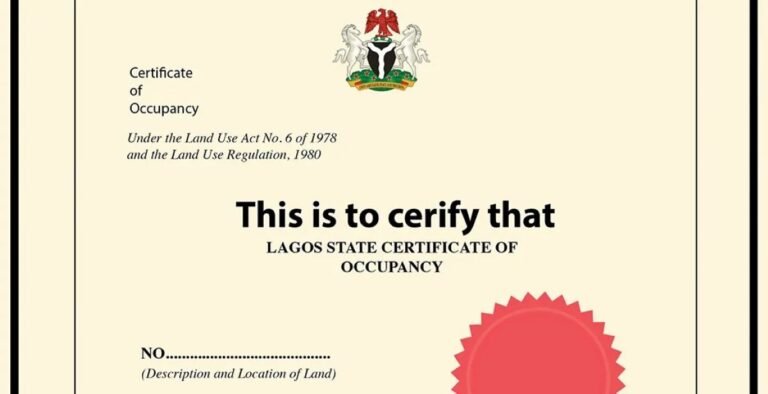
This is the primary statutory title document in Lagos, issued under the Land Use Act of 1978. It confirms a leasehold right to occupy land typically for 99 years which is granted by the State Governor. A valid C of O is strong evidence of legal ownership, but it is not automatically “instant safety”: it must still be checked against Lands Registry records to confirm it wasn’t forged and hasn’t been revoked, contested, or double-issued. Mondaq’s breakdown of the C of O process is a useful reference if you want the fuller legal procedure behind how one is issued.
Governor's Consent
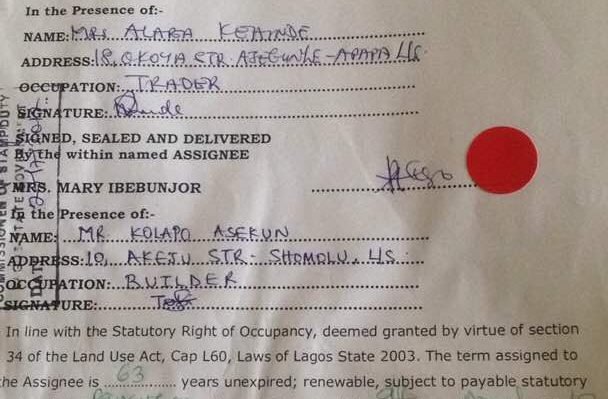
Under the Land Use Act, any transfer of land that already carries a title requires the Governor’s Consent to be legally valid. If a seller skips this step to save time or money, the transaction; no matter how much paperwork is exchanged is not fully perfected in law. Chaman Law Firm’s guide to land registration procedures walks through exactly how consent, charting, and registration fit together as a single process.
Deed of Assignment
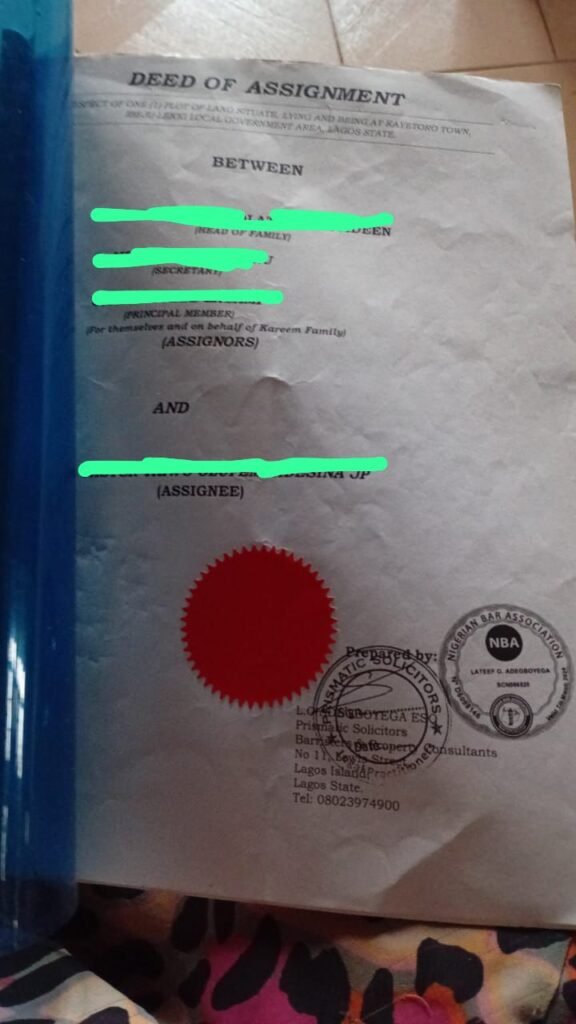
This is the legal document transferring interest in a property from seller to buyer. On its own, a Deed of Assignment is not a title; it’s a transfer instrument that must eventually be backed by proper registration and consent.
Excision and Gazette
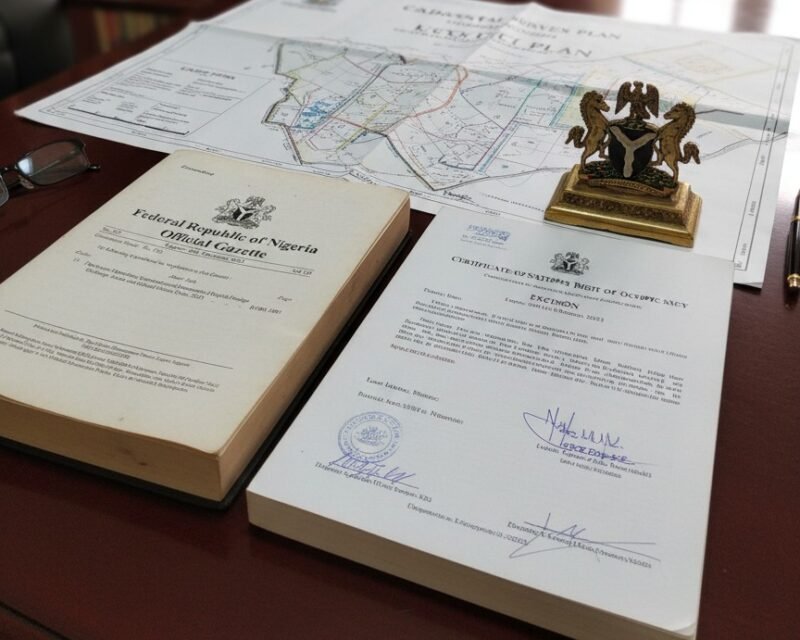
Where family or community land has been formally released (“excised”) from government acquisition and published in the official Gazette, this history matters. It affects whether the land is genuinely free of government claims, one of the most overlooked checks in a rushed transaction.
Registered Survey Plan
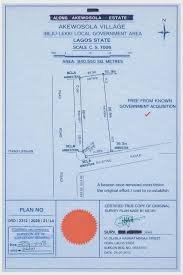
A survey plan defines the exact boundaries, size, and coordinates of the property. Crucially, it must be prepared by a SURCON-registered surveyor and properly charted with the Surveyor-General’s office, an uncharted or unregistered survey offers little real protection, even if it looks official.
The difference between a genuine Registered Survey and a bare C of O trips up more diaspora buyers than almost anything else, because both sound like “the title document” from a distance. We put together a short breakdown to make the distinction clear:
Watch: Registered Survey vs. Certificate of Occupancy, explained for the Nigerian diaspora
If you want the full walkthrough on cross-checking every one of these documents against official records, our companion guide on Verify Land Documents in Lagos goes deeper into each one, and Trustcrow’s C of O guide is a solid plain-language reference if you want more background on how the certificate works before you dive into verification specifics.
How a Lagos State Lands Registry Search Actually Works
A registry search is the process of tracing a property’s official history to confirm who really owns it and whether it’s encumbered. Here’s what it involves in practice.
Step 1: Application. A written application (usually prepared by a solicitor) is submitted to the Lagos State Lands Bureau, requesting a search on a specific title.
Step 2: Fee payment. A modest, government-prescribed search fee is paid — this varies depending on the property and registry office involved.
Step 3: Record inspection. Lands Registry officials pull the relevant file and allow inspection of everything registered against that title: prior transfers, mortgages, liens, caveats, and litigation notices.
Step 4: Findings. The search reveals the true registered owner, any existing encumbrances, and whether the chain of ownership is clean — or whether something doesn’t add up.
Lagos has been digitizing much of this through its e-GIS portal, which has meaningfully reduced processing delays compared to the fully manual process of a few years ago. Even so, interpreting the results correctly — spotting a subtly wrong registration number, a mismatched name, or an outdated survey reference — takes experience most first-time buyers simply don’t have. This is exactly the gap our step-by-step process (below) is built to close.
What a good search should actually confirm. A thorough registry search isn’t just “does a record exist” — it should confirm four separate things: that the current seller matches the name on the registered title, that no undischarged mortgage or lien sits against the property, that no caveat or pending litigation is attached to the title, and that the property hasn’t already been transferred to someone else under a different registered instrument. Missing any one of these four checks can leave a real gap even if the paperwork otherwise looks complete.
Practical tips if you’re running part of this yourself. Always request a Certified True Copy (CTC) rather than relying on a photocopy handed to you by the seller — a CTC is stamped and verifiable directly against the registry’s own record. Keep every payment receipt from the search process; these become part of your paper trail if a dispute arises later. And where possible, have a solicitor submit the application on your behalf — registry staff are generally more responsive to properly formatted legal applications than informal requests from individual buyers, which can meaningfully affect how quickly your search is processed. Chaman Law Firm’s step-by-step search guide covers this exact process in more procedural detail if you want to see each stage laid out.
Red Flags to Watch For in a Lagos Property Deal
Most Lagos property fraud follows recognizable patterns. If you know what to look for, you can catch the majority of scams before money changes hands.
- Refusal to allow independent verification. A legitimate seller has no reason to discourage you from running your own Lands Registry search or hiring your own surveyor.
- Pressure to close quickly, or pay in cash. Urgency and undocumented payments are classic tactics — they remove your paper trail and your time to verify.
- Property priced well below market value. If a deal looks unusually generous, treat that as a reason to look closer, not a reason to move faster.
- Documents that “look official” but don’t check out. Forged Certificates of Occupancy and survey plans often contain subtle errors — mismatched registration numbers, inconsistent stamps, or names that don’t align across documents.
- Vague answers about “settling the community.” This is frequently code for an unresolved omo onile claim being passed on to you.
- An agent who isn’t verifiable. Confirm that the agent or brokerage is properly registered with the Lagos State Real Estate Regulatory Authority (LASRERA) before you engage further.
- Multiple recent Deeds of Assignment on the same property. This can indicate the land has already been sold more than once.
If any of these show up in a deal you’re considering, that’s the moment to pause; not push through. Our detailed breakdown of specific scam patterns in Land Scams in Lekki and the broader Real Estate Scams in Lagos Nigeria walk through real, documented cases so you know exactly what these look like in the wild. If you’re already worried about a specific property, don’t wait until more money is on the line. Book a Consultation and we’ll help you assess it directly.
Our Comprehensive Due Diligence Process: Step by Step
This is the actual process our team runs on every property before we present it to a client, refined over years of transactions across Lekki, Victoria Island, Ikeja, and Ajah.
Step 1: Initial Property Assessment
We conduct a physical, on-site inspection, not a review of photographs, assessing the property’s condition, surrounding infrastructure, and neighborhood context, alongside a preliminary review of the documents provided by the seller. You receive: an initial assessment summary flagging any early red flags.
Step 2: Title Verification and Legal Checks
We run a full search at the relevant Lands Registry, scrutinize the Certificate of Occupancy, Governor’s Consent, and Deed of Assignment for authenticity, and, for higher-value or complex transactions, engage independent property lawyers for an added legal opinion. You receive: a Lands Registry search report and legal opinion where applicable.
Step 3: Survey and Boundary Confirmation
We review any existing survey plan for accuracy and registration status, and where needed, commission a new SURCON-registered survey to confirm exact boundaries and prevent future disputes with neighboring landowners. You receive: a verified or newly registered survey plan.
Step 4: Environmental and Structural Assessment (where applicable)
For older buildings or higher-value properties, we can arrange environmental checks (flood risk, soil conditions) and structural surveys by qualified engineers. You receive: a structural/environmental report where commissioned.
Step 5: Financial and Transaction Scrutiny
We review every transaction document, advise on secure payment channels and escrow options, and verify the seller’s identity and legal authority to sell. You receive: guidance on secure payment structuring.
Step 6: Reporting and Communication
Every finding is compiled into a clear due diligence report, with proactive updates throughout so you’re never left wondering where things stand. You receive: a full due diligence report with our recommendation.
This process is the backbone of every transaction we handle as your Real Estate Broker in Lekki Lagos, and the same standard applies whether you’re buying in Ikeja, Victoria Island, or Ajah.
What Lagos Real Estate Due Diligence Actually Costs
This is the part most guides with including our own earlier version of this page leave out. Here’s a realistic breakdown.
Lands Registry search fee:
Typically a modest, government-prescribed token fee, though it can vary depending on the specific registry office and property involved.
Survey fees:
According to 2026 pricing from Lagos-based SURCON-registered surveyors, land survey costs range roughly from ₦425,000 to over ₦4 million, depending on the zone (premium areas like Lekki, Ikoyi, and Victoria Island command higher fees) and plot size. A mandatory statutory fee, non-negotiable, and payable directly to the Ministry makes up the bulk of this cost.
Governor's Consent and registration costs:
These include consent fees, stamp duty, capital gains tax, and registration charges, and are commonly estimated at a percentage of the property’s value (typically single-digit percentages, though the exact figure depends on current government rates and property specifics).
Legal fees:
Independent property lawyer fees vary by transaction complexity and property value, and are worth negotiating upfront with a clear, itemized quote.
Total additional costs:
Once you combine registry, survey, legal, and registration costs, total additional expenses commonly land somewhere between 8% and 12% of the property’s value, sometimes more for premium zones or properties with title complications.
ATLAS Realtors' professional fee:
Our due diligence and consultancy fee is structured as a percentage of the property’s value, confirmed with you upfront after an initial review of your specific property because pricing depends on property complexity, location, and the scope of verification required. As your Lagos Real Estate Realtor, we’d rather give you an honest number early than surprise you later — Book a Consultation for an exact quote on your target property, or Contact Us with any questions before you commit.
A simple way to think about it by property value
| Property Value | Typical Additional Costs (8–12%) | What This Usually Covers |
|---|---|---|
| ₦20M – ₦50M | ₦1.6M – ₦6M | Search fee, mid-range survey, standard legal/registration fees. |
| ₦50M – ₦150M | ₦4M – ₦18M | Higher-zone survey fees, more thorough legal review, full registration costs. |
| ₦150M+ | ₦12M+ | Comprehensive legal opinion, structural/environmental checks, premium-zone survey rates. |
These are illustrative ranges based on typical Lagos market patterns rather than fixed figures — your actual costs will depend on the specific zone, property type, and whether any title complications need resolving. The point of a table like this isn’t precision down to the naira; it’s making sure you budget realistically instead of being surprised midway through a transaction.
While these figures sting on paper, they are consistently smaller than the cost of a single dispute, a forged title, or a multiple-sale scam — all of which can cost far more than the entire due diligence process combined.
Buying Lagos Property From the Diaspora
A growing share of the buyers we work with are Nigerians living abroad and diaspora buyers face a specific version of these risks: you often can’t visit the property yourself, verify documents in person, or spot local red flags from a distance. This is precisely why remote-friendly due diligence matters so much.
Our process is built to work fully remotely: video-guided inspections, registry searches conducted on your behalf, and full reporting sent digitally wherever you are. We regularly support clients purchasing property in Nigeria from Australia, Canada, the UK, Dubai, and the United States — if you’re researching from one of these locations, we’ve put together country-specific guides: Buy Property in Nigeria from Australia, Buy Property in Nigeria from Canada, Buy Property in Nigeria from the UK, Buy Property in Nigeria from Dubai, and Buy Property in Nigeria from the USA.
If you’d rather read the general risks and safeguards that apply to any diaspora purchase before narrowing to your specific country, our guide on Buying Property in Nigeria From Abroad is the right starting point, and pairs well with our practical walkthrough on how to Verify Land Documents in Lagos before you commit to a property remotely. And if you want a dedicated point of contact who specializes in this exact situation, our Diaspora Real Estate Broker in Nigeria service exists specifically for that — Contact Us and we’ll match you with the right person on our team.
Where to Buy: A Quick Note on Location
Due diligence risk varies meaningfully by location, not just by document quality. If you’re still deciding where to buy, it’s worth reading our comparison of Lekki vs Ajah vs Ibeju-Lekki, our overview of the Best Areas to Buy Property in Lagos, and if Ajah specifically is on your radar, our guides on whether Ajah Is a Good Place to Buy Land, current Ajah Land Price trends, and practical steps to Buy Land in Ajah. For current Land Prices in Lekki Lagos, we track and update pricing regularly as the market shifts.
Whichever area you’re considering, our team as your Real Estate Consultant in Lagos can walk you through location-specific risk before you commit to a property, whether you’re focused on Ikeja, Victoria Island, or Lekki. If Ajah is on your shortlist, take a look at current Ajah Land for Sale listings once you’ve verified the area fits your goals, and Book a Consultation if you’d like our take on a specific plot before you commit.
Common Due Diligence Mistakes Even Careful Buyers Make
Beyond outright fraud, there’s a second category of risk: honest mistakes made by buyers who do care about verification but skip steps without realizing it. A few of the most common:
Trusting a document because it “looks official.” Forged Certificates of Occupancy and survey plans are often visually convincing — correct fonts, plausible stamps, believable formatting. Visual inspection alone is not verification; the document has to be checked against the actual Lands Registry record.
Assuming a Deed of Assignment is the same as a title. A Deed of Assignment is a transfer instrument, not proof of ownership on its own. Without Governor’s Consent and proper registration, the transfer isn’t fully perfected under Nigerian law — no matter how many pages the deed runs to.
Skipping the survey because “the boundaries look fine.” Visual boundaries and legally registered boundaries are not the same thing. An unregistered or outdated survey plan offers little protection if a neighboring landowner later disputes where your plot actually starts and ends.
Negotiating away the statutory survey fee. Some buyers are tempted by surveyors offering to “waive” or reduce the mandatory government survey fee. This is a direct red flag — the statutory portion is non-negotiable, and a surveyor offering to skip it is very likely producing an unregistered, unenforceable plan.
Paying before the search results come back. Under time pressure, it’s tempting to pay a deposit “to secure the deal” while searches are still pending. This removes your main point of leverage — once money changes hands, your ability to walk away cleanly if something turns up is far weaker.
Treating due diligence as a one-time checkbox instead of a process. Verification isn’t a single document check — it’s title history, survey accuracy, seller legitimacy, and financial transaction safety, all reviewed together. Missing even one of these categories can leave a real gap.
Most of these mistakes aren’t caused by carelessness — they’re caused by not knowing what a complete verification process actually looks like. That’s the gap our six-step process above is designed to close. As your Lagos Real Estate Realtor, we’d rather catch these issues before you sign anything — Book a Consultation and we’ll review your specific situation with you.
Frequently Asked Questions
How much does a land search cost in Lagos?
Land Registry search fees are relatively modest government-prescribed charges, though they vary by registry office and property. The larger costs in a transaction typically come from survey fees, legal fees, and registration charges rather than the search fee itself.
How do I verify a Certificate of Occupancy myself?
You can request a search directly at the Lagos State Lands Bureau or through the e-GIS portal, but interpreting the results — confirming the registration number matches, checking for prior encumbrances, and spotting forged elements — is where most buyers benefit from professional support.
How long does Lagos real estate due diligence take?
Timelines vary by property complexity, but a thorough process — registry search, survey verification, and legal review — typically takes anywhere from a few days to a few weeks, especially where Lagos’s digitized e-GIS system is used.
Can due diligence be done remotely from abroad?
Yes. Video-guided site inspections, registry searches conducted on your behalf, and digital reporting make it possible to complete full due diligence without being physically present in Lagos — this is a core part of how we support diaspora clients.
What’s the difference between a Certificate of Occupancy and a Registered Survey?
A Certificate of Occupancy is the statutory title document confirming your right to occupy land; a Registered Survey defines the property’s exact boundaries and dimensions. You generally need both verified — one without the other leaves gaps in your protection.
What happens if I skip due diligence and something goes wrong?
Buyers who skip verification risk financial loss from fake or double-sold titles, prolonged legal disputes over ownership or boundaries, and — in omo onile situations — repeated extortion demands after the purchase is already complete.
Do I need a lawyer if I already have a real estate broker handling verification?
Yes, generally. A broker’s due diligence process and an independent lawyer’s legal opinion serve different purposes — the broker coordinates the practical verification steps, while the lawyer provides an independent legal read on title validity and transaction risk. For higher-value properties especially, having both is standard practice, not redundant caution.
Is it more expensive to buy property in Lagos as a diaspora buyer?
Not inherently — the underlying government fees, survey costs, and legal fees are the same regardless of where the buyer lives. What often adds cost for diaspora buyers is either paying for travel to handle verification in person, or working with agents who charge a premium for “remote service.” A properly built remote due diligence process, video inspections and digital reporting included, closes that gap without the added travel expense.
Conclusion: Invest With Confidence, Not Assumptions
Lagos remains one of the most rewarding property markets in West Africa — but rewarding and risk-free are not the same thing. The difference between a secure investment and a costly dispute almost always comes down to one thing: whether proper Lagos real estate due diligence was carried out before money changed hands, not after a problem surfaced.
You now know what the title documents actually mean, how a registry search works, what red flags to watch for, what the process really costs, and how it can be handled entirely remotely if you’re buying from abroad. What’s left is simply deciding whether you want to run this process yourself, or have a team that does it daily handle it for you.
If you’re ready to move forward with confidence, Contact Us to discuss your specific property, or go straight ahead and Book a Consultation with our team today.